Wednesday, 25 July 2012

Scanning


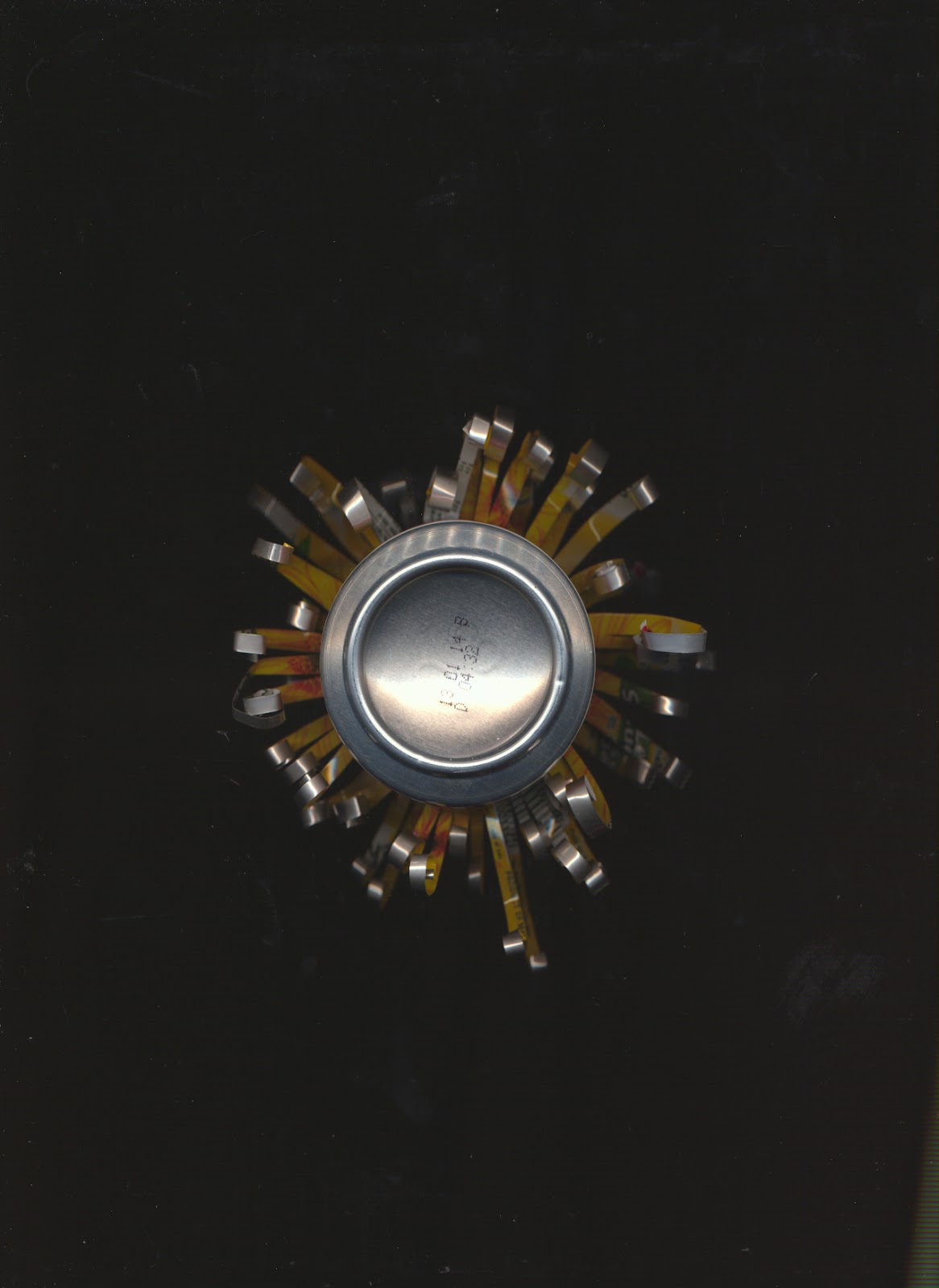
This assignment we have to scan a bunch of things to make them into something totally different, in a form of a picture or a poster. I want to create a picture of day and night. The things that I used are all unrelated, such as necklace, lipstick, medicine, cans and carambola. I used carambola and cans to represent the sky. Carambola represents the stars and the can looks like the sun.


Optical Illusion

This is called Optical Illusion. 
At first sight you would think it is just a horn. But if you look closely it is actually made up 2 faces. I used illustrator to draw these faces, in an expressionist way.

Pandora surprises boxes

 Me and my classmate Li Xin Yu gave each other 5 different things. She gave me a donut box, a pack of tissue paper, a strawberry candy, a fork and some sticker notes. With these totally unrelated things, I created a cute looking radio. All of these things are like candies and by combining them together I think it looks very cute and sweet.

Sixth Sense

I remember the time when i went barbecuing with my friends. It was during night time in the nature. We were circled around the fire, with a pitch dark environment around us. It gave me a strange feeling that I have never felt before. I felt like I was almost melting with the fire. I want to express the feeling that I had at that time. So I used my cellphone to record the sound of the fire, I painted the paper with blue, red and orange to represent the different layers of the fire. Then I crumble the paper to give it a feeling of vagueness. I hope this could recreate that strange feeling that I had at that time.               


Wednesday, 4 July 2012

My Favorite


The next assignment is my 1m by 1m picture and work space artworks. My title is Seasons. As we all know in Malaysia the whole year feels like summer days. there might be some people who have never experienced winter or even a cold windy day. In other countries such as China or Canada, the four seasons are all there. You can experience the differences between summer spring, autumn and winter. In my mind I think the seasons and one's feeling both have similar characteristics, and I also feel that different seasons can definitely affect our emotions as well. I want to convey these seasons and emotions through the use of colors. Spring is the beginning of the year, it represents the beginning of life, like green grass.Autumn to me is like the color yellow, it is the time of fallen leaves. Winter is like white, where its the only season that snows. However, I love Summer the most, as I think it is a colorful season. There are blue sky, green grass, yummy ice cream, picnic, and pretty girls in bikini! 


I also made these artworks to represent different seasons. The photo frame is Spring,the cotton is.Winter, the garbage bin is Autumn and the ice cream is Summer.


Sunday, 1 July 2012

Picture Show


I like this picture. This picture shows a worker. This picture reflects the work environment of this workers, as well as his work situation. Look at his clothes and hat, the funny thing is there is a flashlight on his hat. We can determine he is a mining worker. Due to the pressures of life, he had to do this kind of work , this can be seen from his eyes. This picture is the good image to show a working workers.
I like this picture also, this picture shows the buildings, but with a very special way to show. The author use this vague way allows the audience to be impressed. In fact, this is a very common painting. But the authors used a different way to express and achieve good results. This vague feeling can give the audience a lot of space for imagination, for example, it can allow audience to think of people who live in these houses, as well as what happened inside. 

I don't  like this painting. This painting shows a man sitting on a dead horse. I do not like this picture because this picture makes me feel sad. Although the art is to reflect the real world, but I do not like the picture. Look at this poor horse, I do not know how it is dead, it looked very poor. I am an animal loving person, especially the horse, dog, cat. I do not like to see the animal die.

I don't like this picture also. The author use black and white colors to show swimming people. I like white and black colors, but I do not like use white and black colors to show some harmony things. Look at this picture, it show swimming people, but it looks a little horrible, it looks like a disaster site, for example, the Titanic. This black and white picture give me a horrible feeling, and give me a lot of space for imagine the titanic. In short, I do not like this picture, I like harmony, interesting paintings. 

Monday, 4 June 2012

Cabinet Of Curiosities

The pop icon images are tired and Warhol’s time capsules have had their fifteen minutes of fame. These boxes reek of stale superstardom, copies of copies that once shook institutions. These are a rehash, if not a reboot. Against all odds, we are taken back to where it all started, the 16th century European development that is the Wunderkummer—the cabinet of curiosities. 
Long before the creation of stark white modern unobtrusive galleries, there were only the private museums of things whose values only the owners know. The concept, though, remains until today in museums and galleries. By juxtaposing such disparate objects, comparisons, analogies, parallels within, between and among exhibitions are encouraged to create a discourse that ultimately validates the collection. 
These artist’s cabinets of curiosities—fragments of a culture he has lived in and within—consist of plaster casts of idiot boxes and soda bottles, and copies of popular culture at their kitschiest, packed together tight under the guiding principle of a personal aesthetic. In between the public spectacles are ritual boxes full of thingamajigs—from amulets, to feathers, to rice grain and dried up bladder, to betel nut—used for rituals of the Northern tribes of the Philippines. 
Random texts shout out to us. Ice cold. Happiness. Fifty percent design. Essential component. A typical command task. Zero. Happy om. Words rasterized to become part of the image but still hauntingly speaking its own language, albeit in a postmodern commercial Babel speak. 
Drawing upon Libeskind’s process-oriented metaphor of the labyrinth, De Guia’s assemblages strongly conjure the image of a maze visually.  We are maze-viewers looking at strange labyrinths without paths. There are no corridors nor exits. What we have are boxes within boxes. Or rooms within rooms, a concept that the artist has been playing with in his past paintings. 
Museums in their own rights, complete with glass covers and cotton beds to reinforce the value of decontextualized ethnographic fragments, we walk the artist’s museums’ “active paths” visually and textually, reconstructing paradigmatic relationships between exhibits. 
In “S+V=P (Sex+Violence=Profit )": guns in cotton beds and James Bond; red, red roses and crimson lips; and a whole lot of sitting Gods. In “Ice Cold Happiness": casted Coke bottles stamped with some designs; four televisions; Washington; a ritual headdress and a sheaf of rice. In "Essential Component": a naked female; Astroboy; a breast; a skull; a flower; some toys; four televisions; and a collection of things used to harvest rice. In "Zero" : five televisions bearing images of kissing lovers, woman smoking, and another woman slashing; Mickey Mouse; an orchid; and a small plaster relief depicting life in the Rice Terraces up North. In "All The World‘s A Stage": Gandhi; Elvis Presley pointing a gun; casted bones distinctly marked with numbers; a saint; a pack of cigarettes; dried twigs; and an Ifugao home relief. And finally, in “Happy Om”: painted copy of a publicity image of a sewing brand, with the mutilated tagline satirizing religion; Marilyn Monroe; a relief of a carabao and a hut; three televisions; comic strips with erased thought balloons, a God with some twine; and the usual contents of a ritual box. 
It is not the things, but time and spaces, that Kawayan De Guia forcefully puts together in these six assemblages. These are but shards of a shattered whole. Which is precisely the point of labyrinthine museums. There is no grand unicursal narrative to follow. What we have—behind, above, and with these fragments—are a multitude of narratives and wholes and realities irreconcilable. De Guia’s collections are labyrinths wherein we are invited to observe spaces with such narrative potentials, but succinctly without passages.
Doing thus, the artist has rendered visible the 21st century Zeitgeist. With the global gates open and barriers broken, one learns to fuse survival fundamentals such as religion and consumerism without blaspheming. As with everybody else, the artist compartmentalizes. In a state of flux, he finds fixed states. In line with the rebooting to Wunderkummer, the artist freezes all his processes, finds borders and categorizes values. As with Libeskind’s conclusion on the labyrinthine museum, the artist’s movement through the nonlinear discursive space is ultimately, decidedly, a linear one. The individual cannot win against the system. But he can make sense of it and reorder its unruly exhibits according to his own interests and sensibilities. 
Beyond show, beyond shock, beyond pop, these Wunderkummer are De Guia’s impenitent yet truly earnest “Happy Oms.”